Saturday, April 2, 2011

Larkspur pink flowers info & pics


Delphinium is a genus of about 300 species of perennial flowering plants in the buttercup family Ranunculaceae, native throughout the Northern Hemisphere and also on the high mountains of tropical Africa.The common name, Larkspur, is shared with the closely related genus Consolida.

The leaves are deeply lobed with 3-7 toothed, pointed lobes in a palmate shape. The main flowering stem is erect, and varies greatly in size between the species, from 10 centimeters in some alpine species, up to 2 meters tall in the larger meadowland species; it is topped with a raceme of many flowers, varying in color from purple and blue to red, yellow or white. The flower has five petal-like sepals which grow together to form a hollow pocket with a spur at the end, which gives the plant its name. Within the sepals are four true petals. The seeds are small and often shiny black. The plants flower from late spring to late summer, and are pollinated by butterflies and bumble bees. Most species are toxic. Despite the toxicity, Delphinium species are used as food plants by the larvae of some Lepidoptera species including Dot Moth and Small Angle Shades.

Other names are, lark's heel (Shakespeare), lark's claw and knight's spur. The scientific name comes from the Latin for dolphin, alluding to the shape of the opening flower.

Larkspur pink flowers

boronia flower info & images

These are small, woody, evergreen plants, found in south-western Australia. Boronias generally grow in open forests and woodlands. They are only rarely found in rainforests or arid areas. Boronias are at their best in the cooler areas of southern Western Australia, the Dandenongs and Mornington Peninsula in Victoria, Tasmania and the Blue Mountains of New South Wales.

The plant has tiny, wiry stems and needle-like leaves. The lovely bell-shaped flowers have four petals. They may be rosy-carmine, pink or maroon and yellow. The flowers appear in spring.

Boronia is renowned for its distinctive perfumed smell, especially B. megastigma. The flowers of Boronia megastigma are collected for flavor and fragrance use. Unfortunately, they are generally somewhat difficult to grow in cultivation. All species require excellent drainage and part shade. Most Boronias need moist but well-drained soil and dappled light. The area around the plants should be kept well mulched. For success with Boronia, the root zone must not be allowed to dry out.

The plant can survive outdoors in California and other similar, mild climates. Otherwise, they may be grown in cool greenhouses.

Boronias will flourish in four parts peat, two parts loam, and two parts coarse sand in a greenhouse that has a minimum winter temperature of 45 degrees.The downside of this plant is that they are hard to grow and tend to drop dead. They are short lived, but worth growing as a temporary plant just for the wonderful perfume.

boronia flower
boronia flower
boronia flower picture
boronia flower wallpaper
boronia flower Image

Thursday, March 10, 2011

Cymbidium orchid Flowers


The beloved Cymbidium orchid yields bountiful tall spikes of many exquisite flowers amid elegant grassy-leaved foliage and short, fat, egg-shaped pseudobulbs.

Plants can stay in bloom for 3 months; the waxy long–lasting flowers make classic corsages and are a commercial cut-flower industry.

Flowers come in just about every shade except blue and purple. The 45 species range from low to high elevations of India to Japan down to Australia, often in exposed habitats in full sun. Some, such as Cymbidium ensifolium, Cymbilium sinense, and cymbidium kanran, are intensely fragrant. While traditional hybrids are large cool-growing hybrids.

The generic name of the cymbidium orchids is from the Greek for “hull of a boat”, referring to the boat-shaped lip.

Cymbidium orchid
Cymbidium orchid
Cymbidium orchid
Cymbidium orchid
Cymbidium orchid

Rose Kardinal

A rose is a flowering shrub of the genus Rosa, and the flower of this shrub. There are more than a hundred species of wild roses, all from the northern hemisphere and mostly from temperate regions. The species form a group of generally prickly shrubs or climbers, and sometimes trailing plants, reaching 2–5 metres tall, occasionally reaching as high as 20 metres by climbing over other plants.


Saturday, March 5, 2011

Nerine Flowers

Nerine is a genus of plants belonging to the Amaryllidaceae family. Native to South Africa, there are about 30 different species in the genus. Nerine have been widely cultivated and much hybridized and are now spread world wide.

It is a bulb plant, with each bulb being about 3–5 cm in diameter. In late winter and spring the plant produces several strap-shaped, dull green leaves, about 20 cm long and 1 cm broad, arranged in two rows. The leaves die down by late spring and the bulb is then dormant until late summer.

In fall each bulb produces a single naked stem about 30 cm tall which bears a cluster of 2 to 12 funnel-shaped pink flowers at their tops. Each flower is about 4 cm diameter.

Overall the plant has similar growing characteristics to the Belladonna Lily, though it is much smaller. Another similar plant is the Lycoris.

Nerine
Nerine
Nerine
Nerine
Nerine
Nerine

Monday, February 28, 2011

Strawberry banksia review

Banksia menziesii, commonly known as firewood banksia, is a species of flowering plant in the genus Banksia. It is a gnarled tree up to 10 m (35 ft) tall, or a lower spreading 1–3 m (4–10 ft) shrub in the more northern parts of its range. The serrated leaves are dull green with new growth a paler grey green. The prominent autumn and winter inflorescences are often two-coloured red or pink and yellow, and their colour has given rise to more unusual common names such as port wine banksia and strawberry banksia. Yellow blooms are rarely seen.

First described by the botanist Robert Brown in the early 19th century, no separate varieties of Banksia menziesii are recognised. It is found in Western Australia, from the Perth (32° S) region north to the Murchison River (27° S), and generally grows on sandy soils, in scrubland or low woodland. Banksia menziesii provides food for a wide array of invertebrate and vertebrate animals; birds and in particular honeyeaters are prominent visitors. A relatively hardy plant, Banksia menziesii is commonly seen in gardens, nature strips and parks in Australian urban areas with Mediterranean climates, but its sensitivity to dieback from the soil-borne water mould Phytophthora cinnamomi makes it short-lived in places with humid summers, such as Sydney. Banksia menziesii is widely used in the cut flower industry both in Australia and overseas.

Strawberry banksia
Strawberry banksia
Strawberry banksia
Strawberry banksia

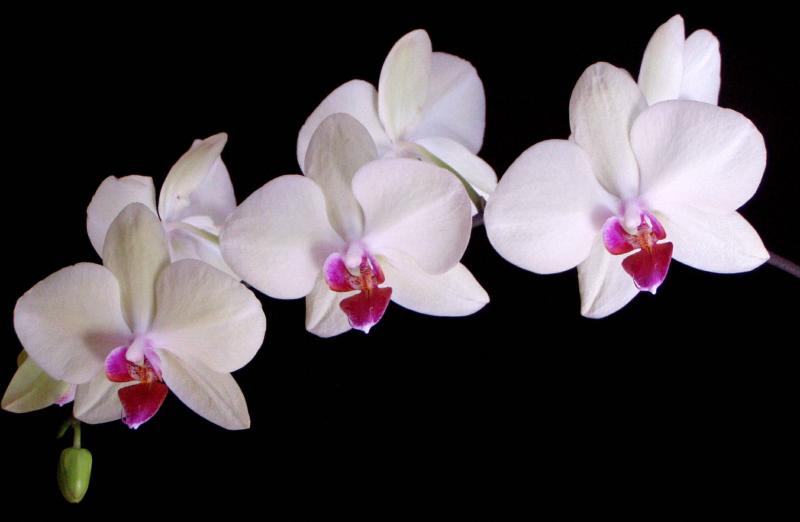
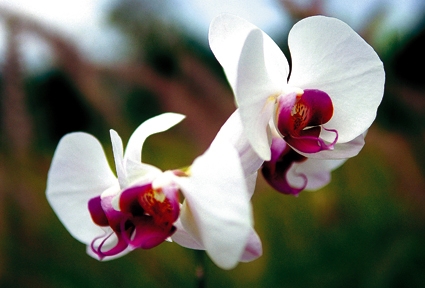
Moon orchid flowers

Moon orchid
Moon orchid
Moon orchid
Moon orchid
Moon orchid
Moon orchid